

The squamosal suture is one of the major cranial sutures found in the human skull. Although it may not be as commonly discussed as the coronal or sagittal sutures, it plays a crucial role in both skull structure and brain protection. Understanding it helps students, healthcare professionals, and curious learners appreciate how the skull forms, grows, and functions.
Understanding Cranial Sutures
Cranial sutures are fibrous joints that connect the bones of the skull. In infants and children, these sutures are flexible, allowing the skull to grow as the brain develops. Over time, they ossify or harden, becoming more rigid in adulthood. Each suture has a unique shape and location—and the squamosal suture is no exception.
What Is the Squamosal Suture?
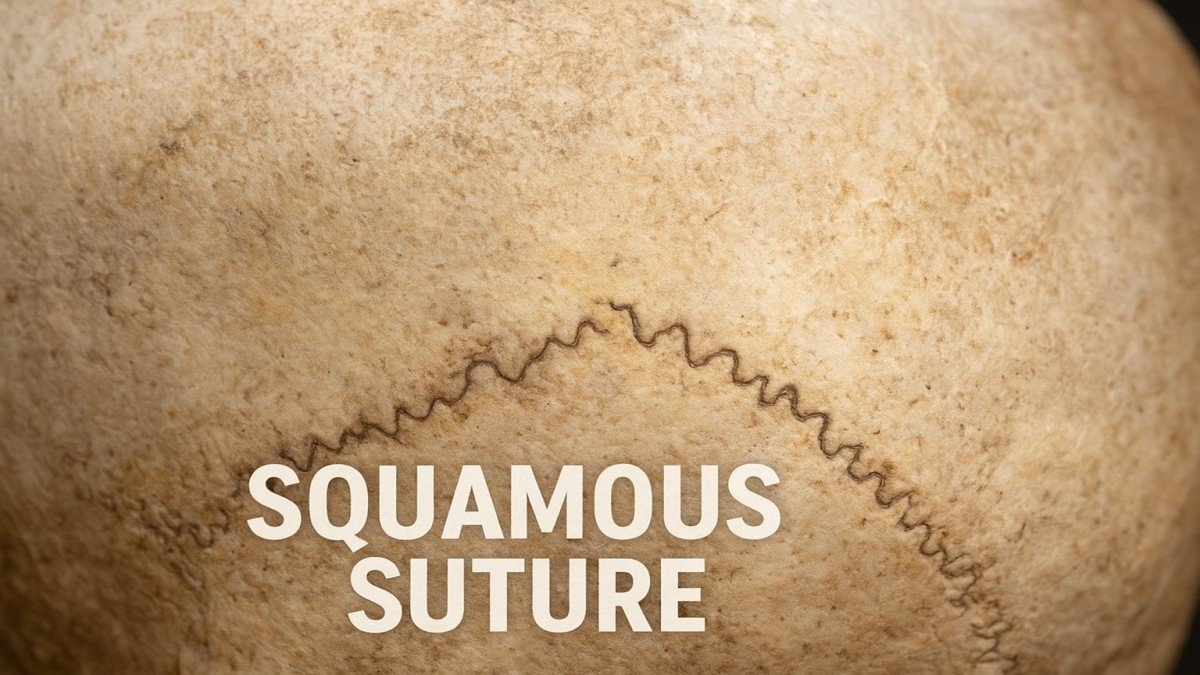
The squamosal suture, sometimes called the squamosal margin, is a jagged, scale-like joint that connects the parietal bone to the temporal bone. Its name comes from the Latin word squama, meaning scale, because its surface resembles fish scales overlapping.
It is found on the lateral side of the skull, contributing significantly to the side profile of the head.
Bones Connected by the Squamosal Suture
1. Parietal Bone
- Forms part of the roof and upper sides of the skull
- Broad, curved, and plays a major role in protecting the brain
2. Temporal Bone
- Houses important structures such as the ear canal, mastoid process, and middle/inner ear
- Involved in hearing and balance
- Forms the lower side portion of the skull
The squamosal suture acts as the boundary where the upper parietal bone meets the squamous (flat) portion of the temporal bone.
Location of the Squamosal Suture
You can locate the squamosal suture by following these landmarks:
- It runs just above the ear region
- Extends from the sphenosquamosal suture (near the temple) to the parietomastoid suture (near the back of the skull)
- Lies below the parietal bone and above the temporal bone
This positioning makes it an important point of reference in anatomy, neurosurgery, and forensic studies.
Function of the Squamosal Suture
Although it may seem like a simple joint, the squamosal suture plays several key roles:
1. Allows Skull Growth
In early life, the suture helps accommodate brain expansion by remaining flexible.
2. Absorbs Mechanical Stress
Its slightly overlapping, scale-like design helps absorb impact and distribute forces across the skull.
3. Protects Temporal Brain Regions
Located near critical sensory structures, proper alignment of the suture contributes to protecting:
- The temporal lobe
- The auditory system
- Balance-related structures
4. Facilitates Cranial Bone Articulation
It allows the temporal and parietal bones to join securely without restricting motion or structural stability.
Development of the Squamosal Suture
In Infants
The squamosal suture is wide and flexible. This allows:
- Rapid brain growth
- Skull expansion
- Safe passage through the birth canal
In Adolescents
The suture gradually begins to interlock, becoming more rigid.
In Adults
It typically becomes fully fused, although fusion patterns vary based on genetics, age, and environmental factors.
In the Elderly
Some individuals experience complete ossification, while others may retain slight flexibility.
Clinical Importance of the Squamosal Suture
The squamosal suture is more than an anatomical landmark—it has significant medical relevance.
1. Craniosynostosis
This is a condition where one or more cranial sutures fuse prematurely. Although squamosal synostosis is rare, when it occurs, it may lead to:
- Abnormal skull shape
- Raised intracranial pressure
- Developmental delays
Early diagnosis and surgery can prevent complications.
2. Head Trauma Assessment
Doctors often examine suture lines when:
- Identifying skull fractures
- Assessing impact points
- Evaluating brain injury risk
Fractures involving the squamosal suture may indicate temporal bone damage, which could affect hearing or balance.
Conclusion
The squamosal suture may seem like a small detail of skull anatomy, but it plays a major role in protecting the brain, enabling skull growth, and maintaining structural integrity. Whether you’re studying medicine, anatomy, or simply exploring how the human body works, understanding this suture offers valuable insight into skull development, function, and clinical conditions.
FAQs
1. At what age does the squamosal suture fuse?
Fusion often begins in adulthood and may complete around age 60, though timing varies widely.
2. Is squamosal synostosis common?
No, it is one of the least common types of craniosynostosis.
3. Can a head injury affect the squamosal suture?
Yes. Fractures in this region may involve the temporal bone and could affect hearing or balance.
4. How is squamosal suture damage diagnosed?
CT scans provide the clearest view of suture structure and potential fractures.
5. Does the squamosal suture affect facial shape?
In infants with premature fusion, it can contribute to head shape abnormalities, but it rarely affects appearance in adults.